

 August 23, 2026
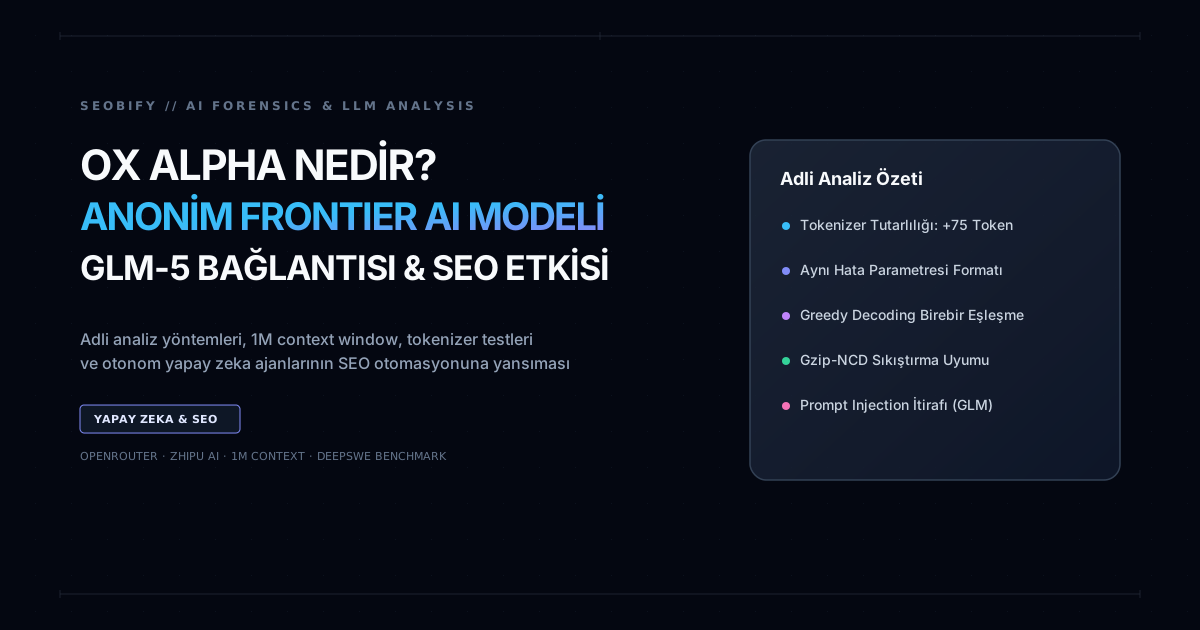
On August 20, 2026, a model called Ox Alpha appeared on OpenRouter under the provider label “Stealth” (model slug stealth/ox-alpha). Its identity is no longer a mystery: Z.ai says it evaluated GLM-5.3-Flash anonymously as Ox Alpha under real-world traffic before the model’s official release (Z.ai: GLM-5.3-Flash).
This article was updated on October 20, 2026 to match the primary sources. Earlier versions repeated community claims that those sources do not support: a 10-task DeepSWE table in which Ox Alpha beat other frontier models, a fixed 75-token hidden prompt, a “99% probability” match with GLM-5V-Turbo and a 744B parameter estimate. Those claims have been removed.
What Is Ox Alpha?
Ox Alpha was the temporary, anonymous name of Z.ai’s GLM-5.3-Flash during its public test on OpenRouter. The key facts from the primary sources:
| Specification | Value |
|---|---|
| Developer | Z.ai (Zhipu AI), per Z.ai’s GLM-5.3-Flash announcement |
| Released model name | GLM-5.3-Flash (z-ai/glm-5.3-flash on OpenRouter) |
| First OpenRouter listing | August 20, 2026, as stealth/ox-alpha |
| Model type | Reasoning model, per OpenRouter’s Ox Alpha description |
| Input modalities | Text, image, video |
| Output | Text |
| Context window | 1,048,576 tokens on most GLM-5.3-Flash endpoints listed by OpenRouter |
| Max output | Varies by provider; Z.ai’s own endpoint lists 131,072 tokens |
| Architecture (Z.ai) | 320B total parameters, 18B active parameters |
| Current status | The stealth/ox-alpha route lists no active endpoints; check the GLM-5.3-Flash page for current providers and pricing |
Benchmark Results: Beyond Expectations?
The earlier version of this article showed a community test on a 10-task subset of the DeepSWE benchmark in which Ox Alpha appeared to beat several frontier models. That table has been removed: ten tasks are too few for a leaderboard, and the result could not be checked against a primary source.
The first-party numbers come from Z.ai, which published its own evaluations for GLM-5.3-Flash. A few examples, as reported by Z.ai against its previous GLM-5.2 model:
| Benchmark (Z.ai’s own evaluation) | GLM-5.3-Flash | GLM-5.2 |
|---|---|---|
| Terminal Bench 2.1 | 84.3 | 81.0 |
| DeepSWE v1.1 | 63.4 | 46.2 |
| Toolathlon Verified | 78.4 | 59.9 |
These are vendor-reported results, and Z.ai notes that scores can vary with settings and environment. Read them as the developer’s own claims, not as an independent, like-for-like comparison with other labs’ models.
Who Solved the Mystery? Forensic Analysis
Before the official confirmation, developers and researchers tried to identify Ox Alpha from the outside: comparing token counts with GLM models, comparing error messages, running identical prompts at temperature 0, using prompt injection to get the model to describe itself, and measuring text similarity. Several of these community tests pointed toward the GLM family.
The question was settled by the developer, not by forensics. Z.ai’s announcement states that GLM-5.3-Flash was evaluated anonymously as Ox Alpha. Some community conclusions were wrong in the details: the earlier version of this article, following those analyses, named GLM-5V-Turbo with 744B parameters, while Z.ai describes GLM-5.3-Flash as a 320B-parameter model with 18B active parameters. A model saying “I am GLM” in its own output is not proof of identity on its own, because models can repeat names that appear in their training data or prompts.
The Stealth Release Trend
Ox Alpha is not the first model to appear on OpenRouter under a temporary anonymous name. In April 2025, for example, OpenRouter revealed that its stealth models Quasar Alpha and Optimus Alpha had been tests of OpenAI’s GPT-4.1 (OpenRouter: Quasar Alpha and Optimus Alpha reveal).
For the developer, a stealth listing provides real-world usage data before launch; Z.ai describes the Ox Alpha period as an evaluation “under real-world traffic.” For users, it means working with a model whose developer, terms and data handling may not be fully clear during the test. Check the route’s current terms before sending client or personal data to any stealth model.
Claude Code + Ox Alpha: Swapping the Model Behind an Agent
Claude Code can be pointed at OpenRouter through environment variables such as ANTHROPIC_BASE_URL and ANTHROPIC_AUTH_TOKEN, as described in OpenRouter’s guide (OpenRouter: Claude Code integration). In principle, that makes the model behind the agent swappable. The same guide warns that Claude Code is optimized for Anthropic models and may not work correctly with other providers.
The practical lesson for SEO teams is that a well-documented workflow (tools, prompts, review steps) can be reused across models, but every model swap needs to be re-tested on your own tasks before you rely on its output.
Implications for SEO and AI Search
Ox Alpha’s emergence is not just an AI model story. It has three practical implications for SEO and digital marketing:
1. Lower Model Costs, Same Editorial Standards
Low-cost models with long context windows make drafting and analysis cheaper for tasks such as:
- Blog content drafts and optimization ideas
- Technical SEO audit summaries
- Structured data (JSON-LD) drafts
- Explaining site speed and Core Web Vitals reports
Lower cost does not lower the bar for publishing. Google asks site owners to “focus on accuracy, quality, and relevance” when content is generated automatically, and says that generating many pages without adding value for users may violate its scaled content abuse policy (Google: using generative AI content). Model output still needs fact-checking, expert review and measurement.
2. AI Visibility Monitoring Becomes Standard
Google says there are no additional requirements or special optimizations needed to appear in AI Overviews or AI Mode, and that you don’t need new machine-readable files, AI text files or special markup (Google Search: AI features and your website). The practical work is the same as for classic search: indexable pages, clear answers and accurate facts.
What changes is measurement. AI Mode traffic is included in the Search Console Performance report totals, so monitor how AI features affect your impressions, clicks and conversions instead of assuming that a new model or tool will improve them.
3. Orchestration > Model: The Future of SEO Automation
The Ox Alpha + Claude Code example translates to SEO as: the team that designs and checks the workflow wins, not the team that picks the model.
The valuable layers in SEO automation will be:
- Task routing: Which task goes to which model (content generation, technical analysis, reporting)
- Quality control: Validation of AI-generated output
- Data integration: Connecting AI output to CRM, analytics, and pipeline metrics
Model names, routes and prices change quickly, as Ox Alpha showed. Build the harness that routes the right task to the right model and re-test it whenever the model underneath changes.
Black-Box Forensic Methodology: A New Discipline
The Ox Alpha case shows both the use and the limits of identifying a model from the outside. These are the methods people applied, and what each can and cannot show:
| Method | What It Measures | Limitation |
|---|---|---|
| Tokenizer analysis | Token counts for identical inputs | Models in the same family can share a tokenizer, so it narrows the family, not the exact model |
| Error string analysis | Format of API error messages | Reflects the serving stack, which a proxy or provider can change |
| Greedy decoding | Output similarity at temperature 0 | Needs identical model versions and settings; serving can still be non-deterministic |
| Prompt injection | Self-description or hidden instructions | Self-reports are unreliable evidence of identity |
| Gzip-NCD | Text compression proximity | Stylistic similarity only; weak evidence on its own |
| Latency fingerprint | Decoding speed profile | Depends on provider hardware and load |
In the Ox Alpha case, these methods produced hypotheses; the confirmation came from Z.ai.
Conclusion: Model Commodity, Orchestration Premium
The Ox Alpha story shows three things:
-
Stealth listings are a launch tactic. A multimodal model with a 1M-token context window reached developers through OpenRouter before its developer was named.
-
Community forensics produce hypotheses, not proof. Z.ai’s own announcement settled the question, and several widely shared details, such as the GLM-5V-Turbo and 744B claims, turned out to be wrong.
-
Value lives in the workflow. Model routes and prices change; your prompts, review steps and measurement are what carry over.
For SEO and digital marketing professionals, the takeaway is to treat new models as interchangeable components: verify facts and figures they produce against primary sources, measure the effect of AI features in Search Console, and build a workflow you can re-test when the model changes.
Sources checked on October 20, 2026: Z.ai GLM-5.3-Flash announcement, OpenRouter GLM-5.3-Flash, OpenRouter Claude Code integration, Google Search: AI features and your website.